Measure the pack
Record bottle, neck, collar, actuator, tube, lock state and available contact surfaces.
Foaming-pump bottles
Develop feeding, placement and tightening around the complete foam-dispenser assembly, bottle stability and the required finished dispensing function.
The engineering challenge
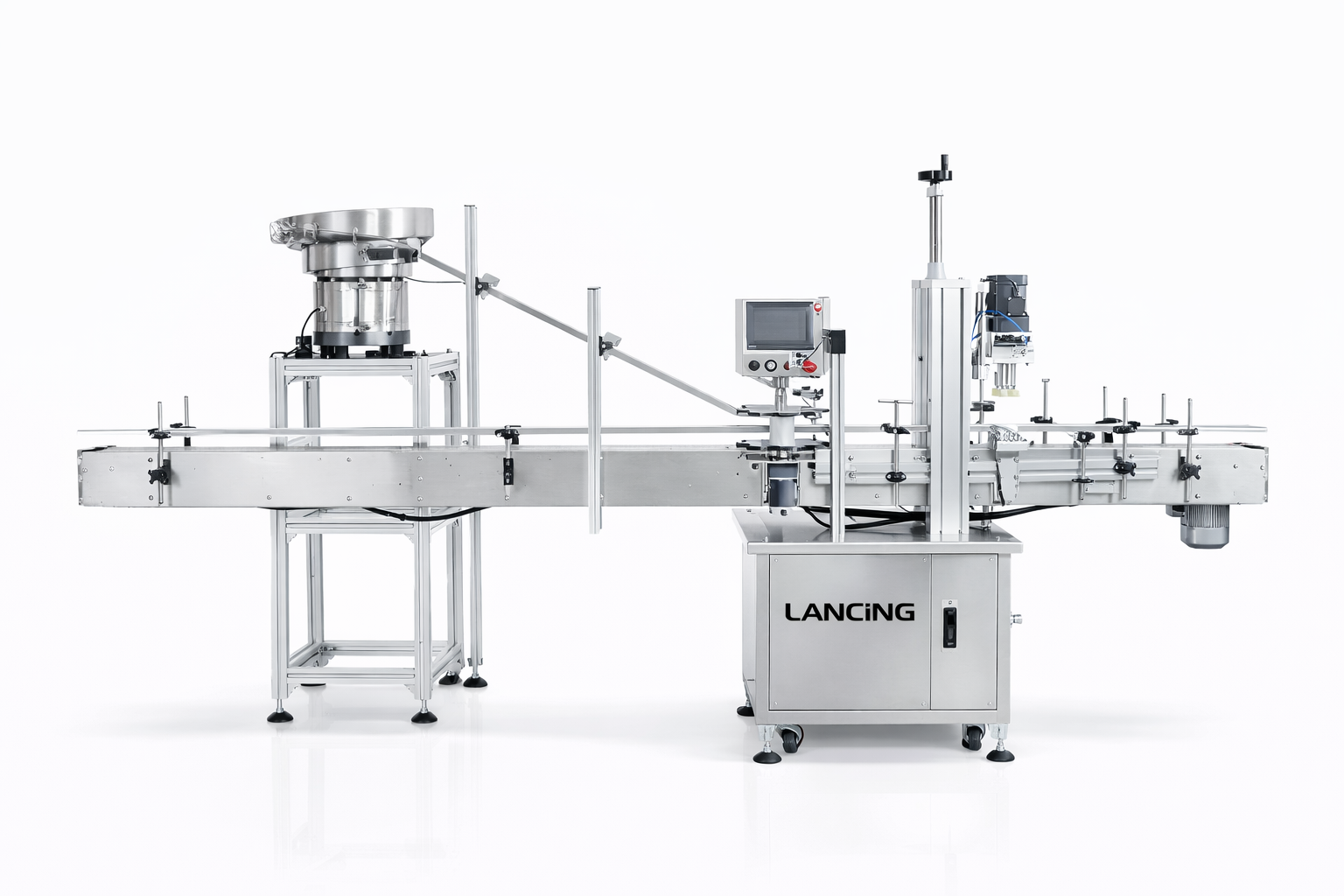
Foaming pumps can present a larger head, a different centre of mass and a different actuator or lock condition from a standard lotion pump. Those differences can change the feeder path, gripping surface, head clearance and bottle restraint.
The capping route should be selected from the actual pump, bottle and product condition. Thread geometry, tube length, bottle stiffness, filled weight and the required dispensing test all need to be part of the format review.
Specification sequence
The same nominal neck finish does not prove that a lotion-pump tool, feeder or recipe will work with a foaming pump.
Record bottle, neck, collar, actuator, tube, lock state and available contact surfaces.
Test the real filled weight and side-load sensitivity at the capping position.
Confirm manual or automatic placement without damaging the head or tube.
Start squarely and apply the agreed chuck, belt or spindle cycle.
Check seating, height, direction, leakage, appearance and dispensing function as specified.
Technology choice
| Route | Operator responsibility | Main qualification point |
|---|---|---|
| Controlled hand tightening | Select, insert and tighten the pump manually. | Suitable only where repeatability, ergonomics and quality can be controlled. |
| Semi-automatic tightening | Place the pump and tube; machine controls bottle location and tightening. | Prove safe contact with the larger head and repeatable bottle support. |
| Automatic inline placement | Replenish components and supervise the line. | Prove bulk feeding, orientation, tube insertion, thread start and reject recovery. |
| Rotary or multi-head system | Operate a higher-throughput integrated cell. | Justify the architecture through sustained output and complete format evidence. |
Compatibility evidence
A large actuator can amplify bottle movement if the head is contacted away from the collar axis. Use the bottle stabilisation guide to define support points and the actuator orientation guide to define the incoming and finished state.
Where the line also handles lotion pumps, create a format matrix that separates shared settings from change parts. Do not assume one feeder or gripper is suitable because the neck thread is the same.
Buyer questions
Use the answers to define the trial; the final machine configuration still depends on representative samples.
The pump head, centre of mass, actuator state and available gripping surfaces can differ from a lotion pump even when the thread looks similar. Those differences affect feeder presentation, head clearance, bottle restraint and the final quality checks.
They can be automated when the supplied components can be separated, oriented, transferred and released without damage or uncontrolled tube entanglement. The normal bulk packing, replenishment and low-level feeder conditions should be included in the trial.
Typical checks include pump presence, square seating, closure height, thread engagement, actuator or lock state, leakage, cosmetic condition and a defined dispensing-function test. Torque may support the plan but does not replace functional acceptance.
Only when the contact diameters, head clearance, bottle support and placement path are proven for both. Shared tooling may be possible, but a separate gripper, chuck insert, guide set or recipe can still be required.
Related guidance
Build a format matrix around the complete bottle, pump and tube assembly.
Compare operator responsibility, feeding scope and production control.
Define seating, height, torque, leakage, appearance and function evidence.
Foaming-pump review
Lancing can review presentation, bottle restraint, tightening, inspection and the appropriate automation level before quotation.
A foaming-pump review should identify which checks belong to the assembly operation and which belong to the finished dispenser. Document the required incoming actuator condition and the condition expected after capping. If a clip, lock or overcap is involved, show when it is fitted and who owns that step.
Keep the bottle, pump and product references together when reporting a trial result. Ask the packaging team to define how dispensing is evaluated alongside the closure and appearance checks. An acceptable-looking collar should not be used as a substitute for an agreed finished-pack review.
Treat it as relevant background only; review the actual foaming-pump assembly and the intended bottle pairing.
Distinguish feeding and placement observations, closure acceptance, cosmetic appearance and the finished dispenser checks specified by your team.