
Characterise
Record collar, actuator, nozzle, overcap, tube and bottle-neck geometry.
Fine-mist and atomiser closures
Specify feeding, dip-tube insertion, thread start and finished-pack checks for compact fine-mist sprayers without treating them as a smaller trigger pump.
The engineering challenge
A fine-mist sprayer, sometimes called an atomiser pump, combines a threaded collar, a small actuator or nozzle and a dip tube. Some formats also arrive with a removable overcap. The machine must control the complete supplied assembly rather than rely on nominal thread size alone.
Nozzle shape, overcap security, actuator direction, tube curvature and bottle-neck opening can all affect the feeder, gripping point and release path. Trials should use the production component as packed by the closure supplier.
Process sequence
Each stage should be trialled with the longest, most curved and most difficult normally supplied components, not only the most convenient sample.
Record collar, actuator, nozzle, overcap, tube and bottle-neck geometry.
Prove separation and orientation from normal bags, cartons or trays.
Guide the tube into a stable bottle without catching the neck rim.
Start the collar squarely before the validated tightening stage.
Check seating, direction, appearance, overcap condition and function as agreed.
Closure comparison
Use the actual closure family to define feeding and bottle-control requirements.
| Feature | Fine-mist sprayer | Lotion pump | Trigger sprayer |
|---|---|---|---|
| Head geometry | Compact actuator or nozzle; may include an overcap. | Actuator and collar usually provide a broader contact area. | Wide trigger body with significant directional overhang. |
| Orientation need | Depends on nozzle, overcap and final presentation. | May require a defined actuator or lock direction. | Often requires a clear final trigger direction. |
| Primary handling risk | Nozzle contact, overcap disturbance and tube entry. | Actuator rotation, cosmetic marking and tube entry. | Overhang clearance, centre of mass and long-tube control. |
| Shared-line decision | Confirm feeder path, gripping surface, head clearance, bottle support, tooling and acceptance separately for every format. | ||
Machine selection
For short runs and frequent format changes, an operator may place the sprayer and tube before a controlled semi-automatic tightening cycle. Automatic placement becomes more valuable where sustained output, repeatability or operator handling is the limiting factor.
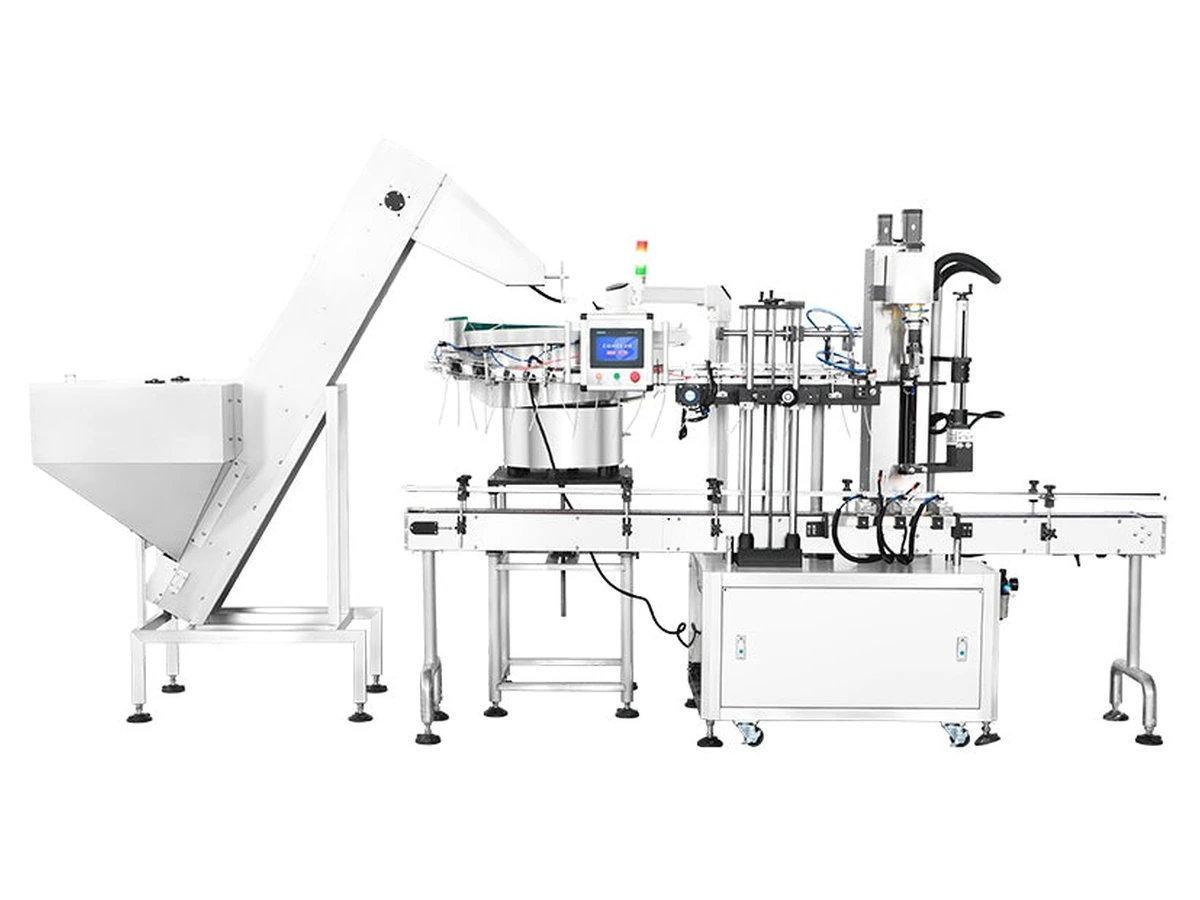
A bulk feeder must be qualified with normal component packing and replenishment. The pump-cap feeding and placement machine explains the feeder interface, while the automatic inline capper shows how bottle transport, placement and tightening can be controlled as one cell.
Buyer questions
The answers are starting points; the final route depends on the exact bottle, sprayer and supplied component condition.
It can stay on only when the overcap is secure, provides a safe contact surface and does not conceal a required orientation or quality check. If it can loosen, mark or rotate during feeding and tightening, the overcap condition needs its own trial or a different handling sequence.
Grippers, guides and tightening contact should act on approved surfaces rather than the outlet or decorative actuator. Use finished components during trials and agree acceptable cosmetic condition under consistent lighting before the tooling is finalised.
Not every format does. Direction becomes important when the nozzle, label, overcap, tamper feature, carton or customer presentation requires a datum. State the incoming and finished condition and how direction will be measured.
They can share equipment only when bottle control, feeder presentation, tube insertion, head clearance, gripping surfaces and tightening tooling are validated for both families. Separate change parts or recipes may still be required.
Related guidance
Characterise tube curvature, packing, feeder level and handover behaviour.
Compare the complete bottle, thread, collar, actuator and tube combination.
Define the checks and reject logic needed for the finished sprayer pack.
Fine-mist application review
Lancing can review the component presentation, tube-entry risk, capping route and finished-pack checks before a proposal is prepared.
Protective overcaps
A pre-fitted overcap can protect the nozzle and sometimes provides a useful handling surface, but only when it stays attached through normal bulk packing, feeder movement, transfer and tightening. It must not hide the pump datum or prevent the required seating and orientation checks.
If the overcap is supplied separately, treat it as another controlled station. The line may need cap separation, orientation, a press or snap application, bottle support, presence and height checks, reject tracking and a known restart sequence. The overcap load must not disturb a pump that has already been threaded and tightened.
The pump-overcap handling guide compares pre-fitted, post-capping and manual routes and lists the component evidence needed for a trial.